Boston Scientific Assessment Guide: Format, Question Types, and Practice Strategy (2026)
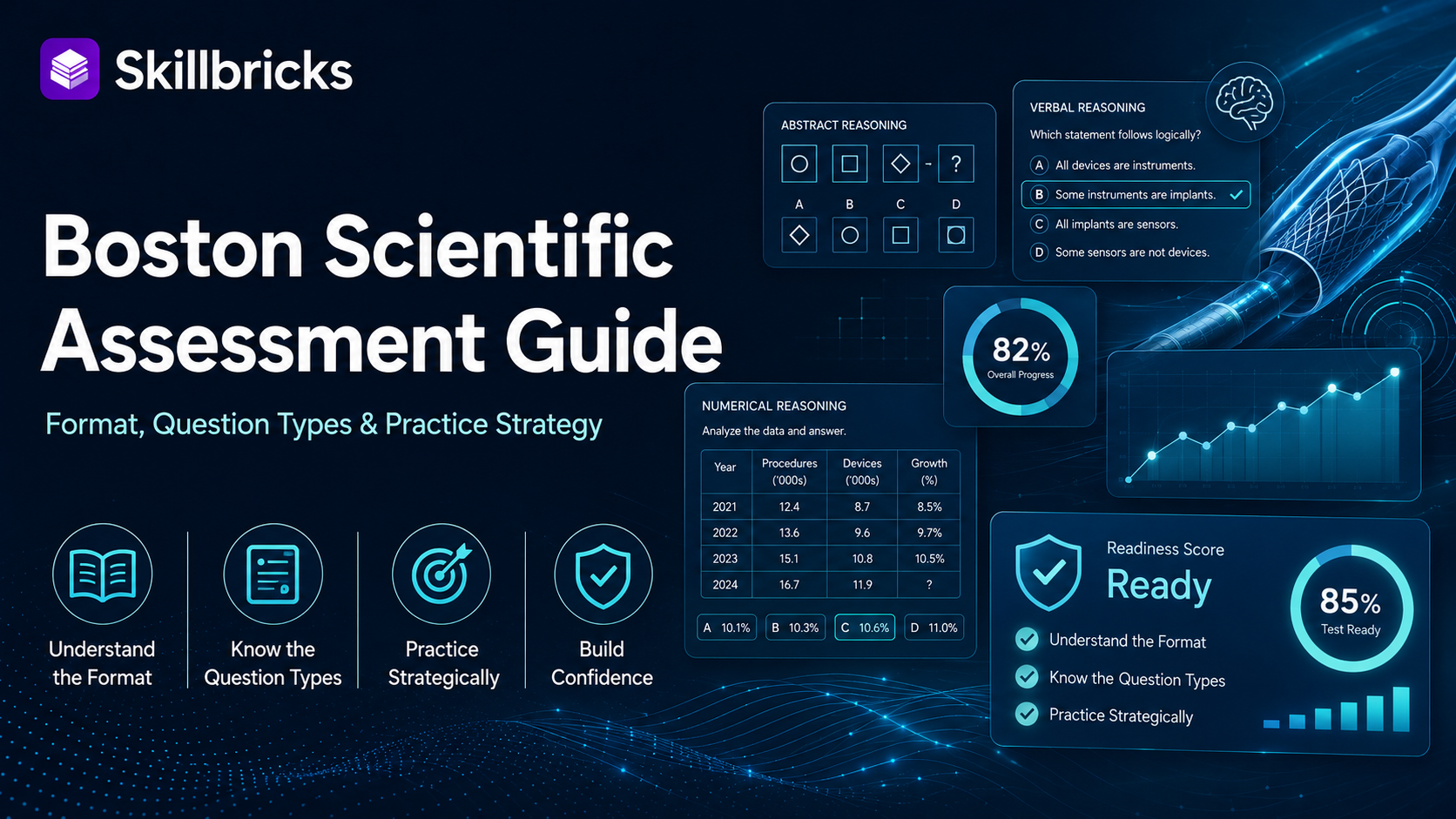
If you are applying to Boston Scientific and just got an email inviting you to complete an online assessment, you probably want to know exactly what you are walking into, how it is scored, and whether you can prepare for it.
The short answer: yes, you can prepare, and preparation makes a real difference. This guide covers the Boston Scientific hiring process, the type of aptitude test you are most likely to see, the question types to expect, realistic score targets, and a practice plan that builds the reasoning speed these tests reward.
Does Boston Scientific use the PI Cognitive Assessment?
Not typically. Boston Scientific's online aptitude testing is most commonly delivered through SHL, usually on SHL's Talent Central platform, with a separate personality questionnaire for cultural fit. That is different from the Predictive Index (PI) Cognitive Assessment used by some other employers.
Here is why it still matters if you have been practicing PI-style questions: SHL and PI test the same three families of reasoning, which are verbal, numerical, and abstract. The formats and timing differ, but the underlying skills, which are fast pattern recognition, quick mental math, and reading for logic under time pressure, are the same. Practice on those skills transfers directly, especially for the abstract reasoning section, which looks nearly identical across both test providers.
The Boston Scientific hiring process
The process varies by role and location, but candidates generally move through these stages:
- Online application. Submit your resume and details through the Boston Scientific careers portal.
- Recruiter phone screen. A short call, often around 30 minutes, to confirm your background, motivation, and fit for the role.
- Online assessment. For many roles you will receive an emailed link to complete SHL-style aptitude tests and, in some cases, a personality questionnaire. This is the stage this guide focuses on.
- Interviews. One to three rounds, which may be virtual or in person, with the hiring manager, potential teammates, and sometimes a director. Expect behavioral questions, and for technical roles, role-specific problem solving or a case discussion.
- Final interview and offer. A final conversation, sometimes with senior leadership, followed by a compensation discussion, drug test, and background check.
The full process runs about three to four weeks on average, though technical and engineering roles can take longer. That timeline gives you a real window to prepare between the recruiter screen and the assessment.
What the assessment measures
The aptitude portion is built to measure how quickly and accurately you reason under time pressure. Expect some combination of three sections:
Numerical reasoning. Data interpretation from tables, charts, and graphs, plus percentages, ratios, and word problems. SHL numerical items lean more on reading data than on raw arithmetic, so practice pulling the right numbers out of a table quickly.
Verbal reasoning. Short passages followed by true, false, or cannot say judgments. The skill being tested is reading precisely and deciding what the passage does and does not support, without bringing in outside knowledge.
Abstract reasoning. Shape sequences, matrices, and odd-one-out problems where you identify the underlying rule and apply it. This is the section that overlaps most closely with PI-style practice.
Many roles also include a personality questionnaire. There are no right or wrong answers here. Respond honestly and consistently. The goal is fit, not a score.
Realistic score targets
SHL assessments are usually scored as a percentile against a comparison group rather than as a simple pass or fail, and the bar depends on the role. As a general guide, aim to land in roughly the top third of applicants, which for competitive roles often means a percentile in the high 60s or better. Accuracy matters more than raw speed, so it is better to answer fewer questions correctly than to rush and guess your way through.
Timing strategy that works
The single biggest challenge on these tests is the clock. A few tactics that consistently help:
- Do not get stuck. If a question is eating your time, make your best call and move on. One hard question is not worth three easy ones.
- Answer everything you can reach. There is generally no penalty for a wrong answer on SHL aptitude tests, so never leave a reachable question blank.
- Learn the question types cold. The faster you recognize what a question is asking, the more of your time goes to solving instead of decoding.
- Practice with a timer. Reasoning under time pressure is a trainable skill. Untimed practice builds accuracy but not the speed these tests actually measure.
How to prepare
The most effective preparation is timed, repeated practice on the three reasoning types, so the format feels familiar and your pace becomes automatic on test day.
Skillbricks gives you timed cognitive assessment simulations covering verbal, numerical, and abstract reasoning, with a large question bank, detailed explanations for every question, and per-category analytics that show you exactly where you are losing time. The abstract reasoning and mental-math-speed practice maps directly onto what Boston Scientific's assessment rewards. For the data-heavy numerical items and passage-based verbal items specific to SHL, use Skillbricks to build the underlying speed and precision, then do a few SHL-format samples so the presentation is not a surprise.
A realistic plan: start two to three weeks before your assessment, do short timed sessions several times a week rather than one long cram, and review every question you miss so the same pattern does not catch you twice.
Frequently Asked Questions
Is the Boston Scientific assessment hard?
It is challenging mainly because of the time pressure, not the difficulty of any single question. Candidates who practice the format and pace beforehand find it much more manageable.
Can I retake the assessment?
Retake policies vary by role and recruiter. If you are invited to retake, treat it as a second chance and prepare deliberately in between.
How long is the assessment?
It depends on which sections are included, but plan for roughly 30 to 60 minutes total across the aptitude and personality portions. Your invitation email will usually specify.
Do I need to prepare if I am strong at math or reading?
Yes. These tests reward speed and format familiarity as much as ability. Even strong candidates lose points to the clock without practice.