Spring Health PI Cognitive Assessment Guide: What to Expect and How to Prepare
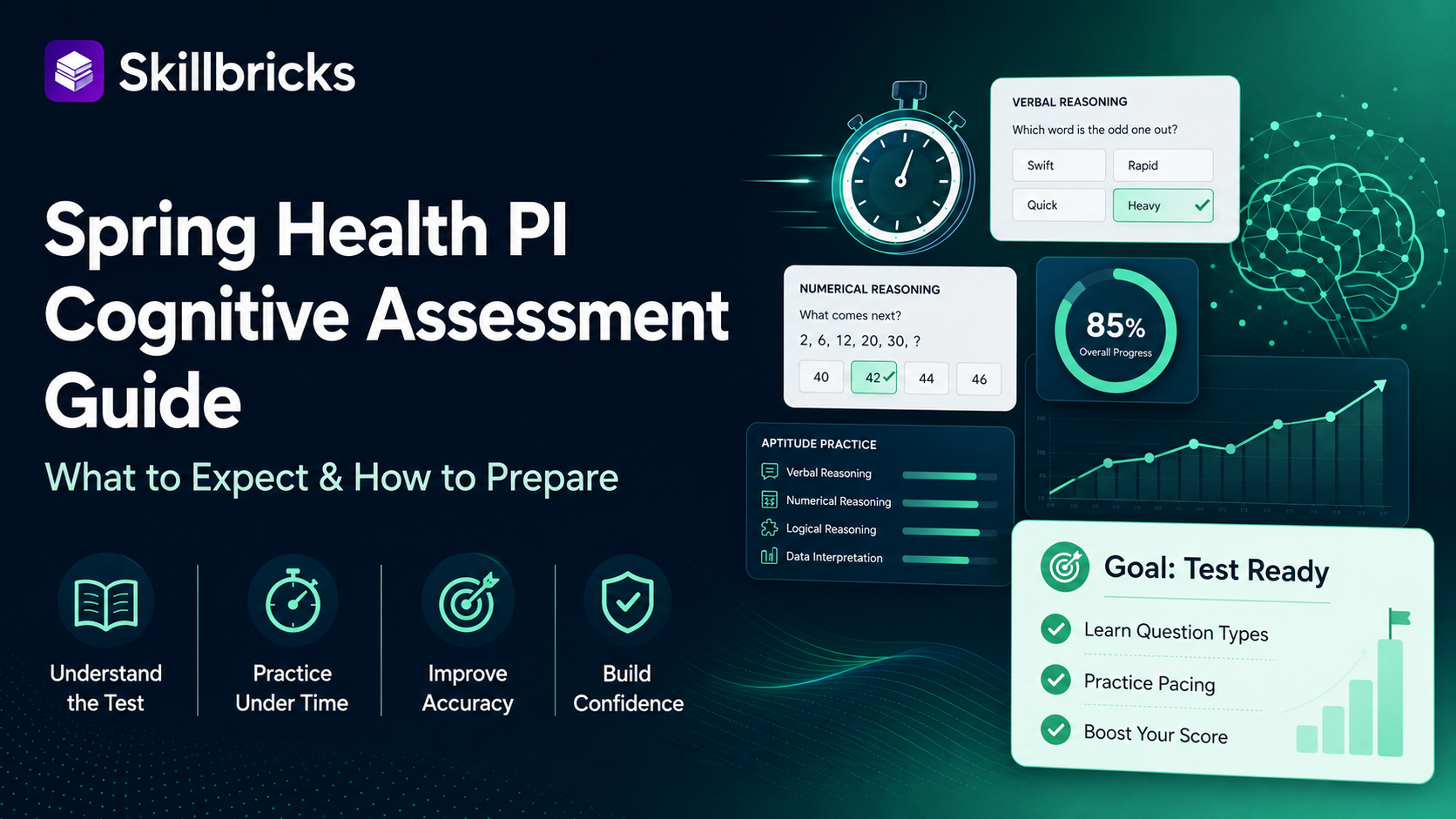
If you are interviewing at Spring Health, there is a good chance you will be asked to take a PI Cognitive Assessment as part of the hiring process. This guide covers everything you need to know about how Spring Health uses the PI test, what the hiring process looks like, and how to prepare so you can walk in confident.
Does Spring Health Use the PI Cognitive Assessment?
Yes. Spring Health includes the PI Cognitive Assessment in its hiring process for a range of roles. Candidates who have interviewed at the company in late 2025 and early 2026 have confirmed that the PI assessment is part of the process, typically administered after the initial recruiter screen and before deeper interviews with the hiring manager and team. The PI assessment is used alongside behavioral interviews and skills assessments to evaluate how quickly candidates can learn, adapt, and process new information. For a fast-growing company like Spring Health, where teams are scaling rapidly and employees need to ramp up quickly, cognitive agility is a key signal hiring managers look for.
About Spring Health
Spring Health is a mental health benefits company headquartered in New York City. Founded in 2016 by April Koh and Adam Chekroud, the company provides employers with a platform that uses AI and machine learning to match employees with personalized mental health care, including therapy, coaching, medication management, and digital wellness tools. The company has raised over $500 million in venture funding across multiple rounds, with a current valuation of $3.3 billion following a $100 million Series E in 2024 led by Generation Investment Management. Spring Health serves over 10 million people through more than 450 employers and strategic payer relationships. Its clients include Microsoft, Target, J.P. Morgan Chase, and Delta Airlines. As of early 2026, the company has approximately 3,700 employees and continues to hire actively across engineering, product, data science, marketing, operations, and clinical roles.
The Spring Health Hiring Process
The hiring process at Spring Health typically takes about three to four weeks and includes several rounds. While the exact steps vary by role, candidates have reported the following general structure:
Recruiter Screen (30 minutes).
A phone or video call where the recruiter reviews your background, discusses the role, and gauges mutual fit. This is also where you will learn about next steps and any assessments you need to complete.
PI Cognitive Assessment.
After the recruiter screen, you will typically receive a link to complete the PI Cognitive Assessment. This is a 12-minute, 50-question timed test that measures verbal, numerical, and abstract reasoning. You can take it remotely on your own time, but you must complete it in one sitting.
Hiring Manager Interview (45 minutes).
A deeper conversation about your experience, how you approach problems, and how your skills align with the specific role.
Team or Cross-Functional Interviews.
Depending on the role, you may have two to three additional interviews with team members, stakeholders from other departments, or senior leaders. Some roles also include a skills assessment or mock presentation.
Final Interview.
For many positions, the last round is a conversation with a VP or senior leader focused on strategic thinking and cultural alignment. Candidates have described the process as professional and well-structured, though some have noted that communication can slow down in the later stages. Preparing early and staying proactive with follow-ups is a good approach.
What Is the PI Cognitive Assessment?
The PI Cognitive Assessment (also known as the PICA or PLI) is a standardized pre-employment test developed by the Predictive Index. It measures general cognitive ability, which is the capacity to learn, adapt, and solve problems quickly. Here is what you need to know about the format: 50 questions in 12 minutes. That gives you roughly 14 seconds per question. Most candidates do not finish all 50 questions, and that is normal. Your score is based on how many you answer correctly. Three question categories. The test mixes verbal reasoning (sentence completion, word analogies, antonyms), numerical reasoning (word problems, number series, basic math), and abstract reasoning (pattern recognition, visual sequences, odd-one-out). Questions rotate randomly. No two tests are identical. The system selects questions from a pool to keep the difficulty level consistent and prevent memorization. No penalty for guessing. If you are running low on time, it is always better to guess than to leave a question blank.
Why Spring Health Uses the PI Assessment
Spring Health is a company that moves fast. With a rapidly growing team, AI-driven products, and the complexity of serving millions of members through hundreds of employer partnerships, the company needs people who can ramp up quickly and adapt to changing priorities. The PI Cognitive Assessment gives hiring managers a data point on how quickly a candidate is likely to absorb new information and handle complex tasks. It is not the only factor in the hiring decision, but it helps Spring Health compare candidates against a cognitive target set for each role. For roles in engineering, data science, product, and operations, this kind of cognitive agility is especially relevant. The test is designed to be role-neutral, meaning it does not test specific technical knowledge or job-related skills. Instead, it measures the underlying ability to learn and think under pressure.
How to Prepare for the Spring Health PI Assessment
The PI Cognitive Assessment is a speed test. The questions themselves are not extremely difficult on an individual basis, but answering them accurately under a 12-minute time limit is the real challenge. Here is how to prepare: Take timed practice tests. The single most effective way to prepare is to practice under realistic conditions. Set a timer for 12 minutes and work through 50 questions. This builds the pacing instincts you need so you are not surprised by the time pressure on test day. Learn the question types. Knowing what to expect eliminates the time you spend figuring out what a question is asking. Familiarize yourself with number series, word problems, sentence completion, antonyms, analogies, and pattern recognition questions before you sit for the real test. Do not get stuck. If a question is taking more than 15 seconds, skip it and move on. You can always come back if you have time. One hard question is not worth two easy ones you never get to. Guess before time runs out. There is no penalty for wrong answers. In the last 30 seconds, fill in answers for any remaining questions. Even random guesses give you a 25% chance on each one. Practice in a quiet environment. When you take the real test, find a distraction-free space with a stable internet connection. Close all other tabs and apps. The 12 minutes go fast, and even a brief interruption can cost you several questions. Review your weak areas. After each practice test, look at which categories gave you the most trouble. If numerical reasoning is your weakest area, spend extra time drilling number series and word problems. If verbal reasoning trips you up, work on antonyms and sentence completion.
Score Target for Spring Health
The PI Cognitive Assessment produces a score on a scale from 100 to 450. The average score is around 250, which corresponds to answering roughly 20 out of 50 questions correctly. Each role at Spring Health has its own cognitive target set by the hiring team. For roles that require high cognitive demand, such as data science, engineering, and product management, the target is typically higher. For operational or support roles, the target may be lower. You will not be told the exact target for your role, but aiming for 25 to 30 correct answers (above the 50th percentile) is a solid goal for most positions. Scoring above 30 puts you in the top tier of test takers. Start Practicing The best way to prepare for the Spring Health PI Cognitive Assessment is to take full-length, timed practice tests that match the real format. Skillbricks offers timed 50-question practice tests with detailed explanations for every answer, so you can identify your weak spots and improve before test day.